How To Pick Tiles That Last In Castle Hill’s Humid Weather
1942 views
Many bathroom renovations in Castle Hill fail within five years. Why? Because while they may match the latest modern bathroom designs 2026, they aren’t engineered for the Hills District’s unique, humid environment.
With average humidity near 65%, standard materials often succumb to moisture damage. To ensure your renovation lasts 25 years, you need to look beyond aesthetics to the science of durability.
As Australian Renovation Professionals and Master Builders with 25+ years in the district, here is your comprehensive guide to selecting tiles, grout, and waterproofing systems that stand the test of time.
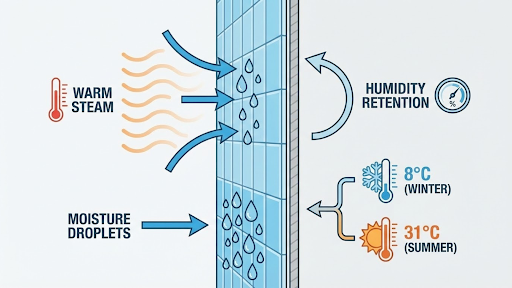
Many homeowners assume that “tiles are tiles” and that any ceramic product will function as a waterproof barrier. This is a dangerous misconception. In reality, tiles and grout are part of a complex ecosystem that must manage moisture migration, thermal expansion, and evaporation.
Castle Hill experiences specific climatic conditions that differ from the coastal suburbs or the drier western plains.
Whether you are looking for affordable bathroom renovations or a high-end luxury spa finish, the physics remains the same. Moisture management is the single most critical factor in your project’s longevity.
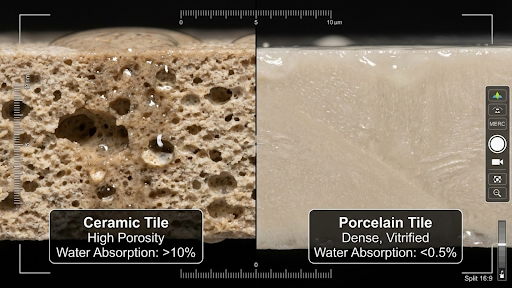
When you walk into a tile showroom looking for bathroom makeover ideas 2026, you will be greeted by thousands of options. To the untrained eye, a $30/m² ceramic tile might look identical to a $100/m² porcelain tile. However, under a microscope, they are vastly different.
The most critical specification for Bathroom Renovations Castle Hill is the Water Absorption Rate.
Standard ceramic tiles are made from red or white clay and fired in a kiln at lower temperatures. They are generally softer and more porous, with a water absorption rate of 3–6%.
In a dry climate, this is acceptable. In Castle Hill’s humid environment, a ceramic tile acts like a slow sponge. Over time, it absorbs moisture through the unglazed back of the tile or through micro-fissures in the glaze. This trapped moisture can cause several issues.
We generally recommend ceramic tiles only for dry areas like laundry splashbacks or powder room walls. We never recommend them for shower floors or primary wet zones.
For any wet area in the Hills District, be it Bathroom Renovations Baulkham Hills, Bathroom Renovations Cherrybrook, or right here in Castle Hill, fully vitrified porcelain is the only responsible choice.
The Verdict: While porcelain costs more upfront, a porcelain installation typically lasts 25 to 30 years. It is the foundation of a “forever” bathroom.
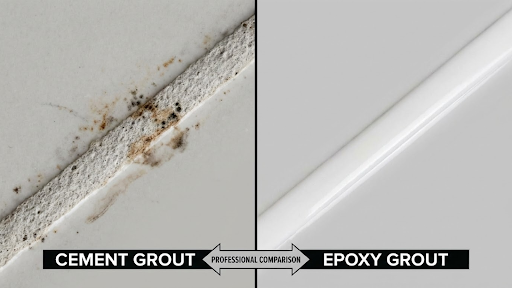
If you ask any Master Builder about the number one cause of bathroom failure, they won’t say tiles. They will say grout.
Traditional cement-based grout is essentially a mixture of sand, cement, and pigment. It is porous by nature and absorbs 15–20% of the water that hits it. In a shower, this means water is constantly soaking into your grout lines, wicking behind the tiles, and testing your waterproofing membrane.
In Castle Hill’s humid environment, damp cement grout becomes a breeding ground for black mould and bacteria. Homeowners often find themselves scrubbing grout lines monthly, only to see the black spots return days later.
For all our modern bathroom renovation Castle Hill projects, we strongly advocate for Epoxy Grout. Unlike cement grout, epoxy is made from two parts: a resin and a hardener.
Epoxy grout is more difficult to work with. It has a short “pot life,” meaning it hardens quickly once mixed. It requires specialised cleaning techniques during installation to prevent a hazy film from forming on the tiles. This increases the labour component of your bathroom renovation cost. However, it eliminates the need for regrouting down the track. We view it as an insurance policy for your renovation.
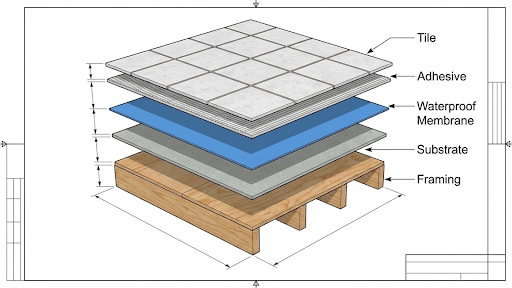
You can buy the most expensive Italian porcelain and the highest-grade epoxy grout, but if the substrate preparation is poor, the bathroom will fail.
Compliance with Australian Standard AS 3740-2021 (Waterproofing of Domestic Wet Areas) is mandatory. However, the standard is a minimum requirement. For our projects in Bathroom Renovations in North Rocks and Bella Vista, we employ a “belt and braces” approach that exceeds the standard.
Porous surfaces like concrete floors or Villaboard walls must be primed. If they are not, they will suck the moisture out of the waterproofing membrane before it cures. This leads to pinholes and weak spots. In Castle Hill’s humid summers, flash-drying of membranes is a risk we manage carefully with specialised primers.
Buildings move. A “bond breaker” is a silicone or fabric tape system installed at wall-floor junctions. It acts as a safety zone that allows the waterproofing membrane to stretch rather than snap when your house settles or expands in the Castle Hill heat. Without this, the membrane would tear at the corners, which is the most common leak point in any bathroom.
We use high-quality, flexible liquid membranes (Class III) applied in multiple coats to the entire shower recess and the bathroom floor. We create a fully “tanked” environment. This ensures that even if water penetrates the tile layer, it is directed to the drain rather than into your timber frame. We verify the dry film thickness using a gauge to ensure it meets manufacturer specifications.
In humid zones, standard rigid glue can crack. We use polymer-modified adhesives (C2S1 or C2S2 rating) that are flexible and moisture-resistant. The “S” rating denotes deformability, which is the ability of the adhesive to flex without breaking the bond. This ensures your tiles stay stuck even when the temperature swings from 10°C to 35°C.
Pro Tip: Be wary of quotes for “cheap” bathroom renovations that don’t specify the waterproofing method. This is the most common area where corners are cut. It leads to leaks and major insurance headaches within a few years.
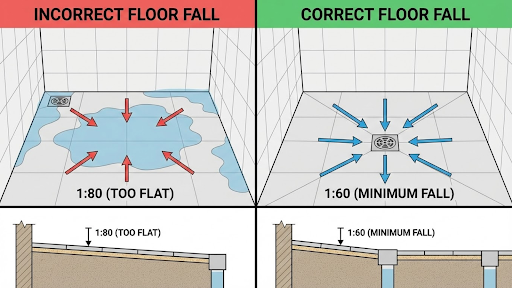
One of the most overlooked aspects of tile selection is how it impacts drainage. In Castle Hill’s humid climate, standing water is the enemy. Water that pools on the floor increases humidity and encourages mould.
Australian Standards require a minimum fall to the waste of 1:80 for the main bathroom floor and 1:60 for shower areas. This means for every 80cm of floor, the level must drop by 1cm.
If your renovation contractor does not calculate these falls correctly before screeding, you will end up with puddles in your shower that never dry. At ARP, we laser-level our screed beds to ensure rapid and complete water runoff.
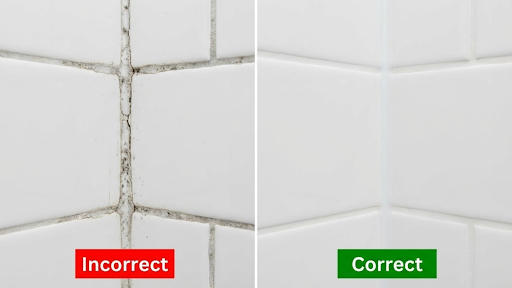
A common DIY mistake is grouting the internal corners where the wall meets the wall, or the wall meets the floor. This is incorrect.
Because different materials like timber frames, concrete slabs, and brick veneer expand and contract at different rates, internal corners are subject to movement. Hard grout will crack in these corners within months.
We strictly use colour-matched sanitary-grade silicone for all internal corners and junctions. High-quality silicone is flexible, antifungal, and waterproof. It acts as an expansion joint that absorbs the movement of the house without cracking. This maintains the watertight seal that is essential for Castle Hill homes.
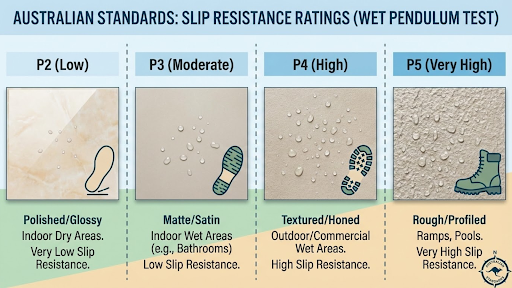
When designing small bathroom renovations or large family en-suites, safety is paramount. A high-gloss polished tile might look like a 5-star hotel, but it becomes a skating rink when wet.
The Australian Standard AS 4586 classifies slip resistance. It is crucial to check the “P-Rating” (Pendulum Test) of any floor tile you select.
Trend Alert: For bathroom renovation trends in 2026, we are seeing a move towards “structured” or “honed” finishes. These matte surfaces offer superior grip, usually P3 or P4, without being rough on bare feet. They are safer for children and the elderly and hide water marks better than polished finishes.
Size matters, but not just for looks.
Large format tiles (600x600mm, 600x1200mm) are increasingly popular in modern bathroom designs 2026.
However, large tiles require a perfectly level floor. If your existing floor is uneven, we may need to use a self-leveling compound before tiling. Large tiles also require “back-buttering,” which is the process of applying adhesive to the back of the tile to ensure 100% coverage. This prevents hollow spots that can crack under impact.
For floor tiles, we recommend looking for a thickness of 10mm to 12mm. Thinner tiles of 6mm to 8mm are often designed for walls. Using a wall tile on the floor is a recipe for disaster. Dropping a heavy perfume bottle or hair dryer could crack a thin tile instantly. Always verify the manufacturer’s intended use.
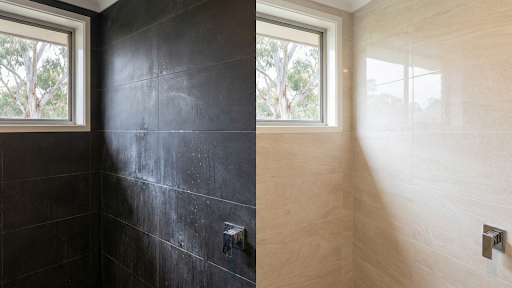
Sydney’s water contains mineral deposits that can accumulate on surfaces over time. This “hard water” isn’t a structural issue, but it is an aesthetic one.
Dark, moody bathrooms in charcoal, black, or navy are stunning and luxurious. However, as the water evaporates in Castle Hill’s humid air, it leaves behind white calcium and mineral deposits. On a matte black tile, these spots are highly visible and require frequent cleaning to maintain that pristine look.
Light grey, beige, limestone, and travertine looks are incredibly forgiving. They hide dust, lint, and hard water marks significantly better. For a “low maintenance” lifestyle, we often recommend mid-tone organic colours such as greige, oatmeal, or soft concrete.
Timeless Design: Trends fade. “Millennial Pink” tiles might look dated in five years. We encourage clients to choose neutral, high-quality “hard materials” for the floor and walls. You can then inject colour through “soft materials” like towels, paint, timber vanities, and brass tapware that are easier to change later.
Many Castle Hill homes feature indoor-outdoor flow. If you are extending your tiling to a patio or balcony, the requirements change again.
Outdoor tiles must meet specific criteria:
Many of our suppliers offer “indoor/outdoor” ranges. This allows you to have the same visual tile available in a smoother finish for inside and a rougher, grip finish for outside. This creates a seamless visual connection while adhering to safety standards.
To keep your bathroom renovation looking new for decades, you need a proactive maintenance strategy tailored to the local environment.
Yearly: If you opted for cement grout and natural stone, schedule a professional “clean and seal.” If you chose porcelain and epoxy grout as ARP recommends, you can skip this step!
We often get asked about bathroom renovation costs and how to budget effectively. It is tempting to look at the bottom line and choose the cheapest quote.
Let’s look at the 10-year cost of ownership to understand the real value.
| Feature | Scenario A: The “Budget” Renovation | Scenario B: The ARP “Master Builder” Renovation |
|---|---|---|
| Materials Used | Ceramic tiles, standard cement grout, and minimum standard waterproofing. | Vitrified porcelain, epoxy grout, tanked waterproofing, extensive prep. |
| Projected Lifespan | $10 Years: Grout discolours by year 4, cracks appear by year 6, leaks by year 8. | 20+ Years: Remains pristine in year 10 and year 20. |
| Total 10-Year Cost | Initial Renovation + Mould Remediation + Full Replacement. | Initial Renovation only. |
The most expensive bathroom you can buy is the one you have to pay for twice. Whether you are in Bathroom Renovations in Lane Cove, Chatswood, or North Shore, investing in quality materials now saves thousands later.
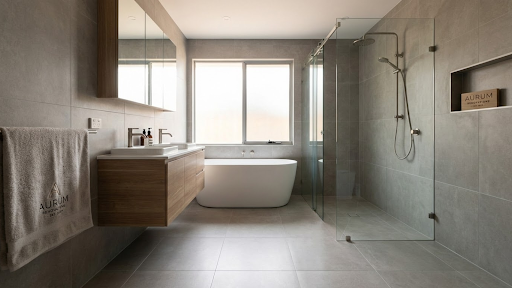
At Australian Renovation Professionals, we don’t just lay tiles. We engineer solutions for the local climate. We understand that a bathroom remodel is a significant investment, and we treat your home with the respect it deserves.
Are you ready to design a bathroom that withstands the Castle Hill humidity and looks timeless? Don’t leave your biggest asset to chance.
Contact us today for a Free Consultation. Let’s build a beautiful, durable space that you will love for decades.